Aimee Mann Mental Illness Album Art Pharmakon Contact Album
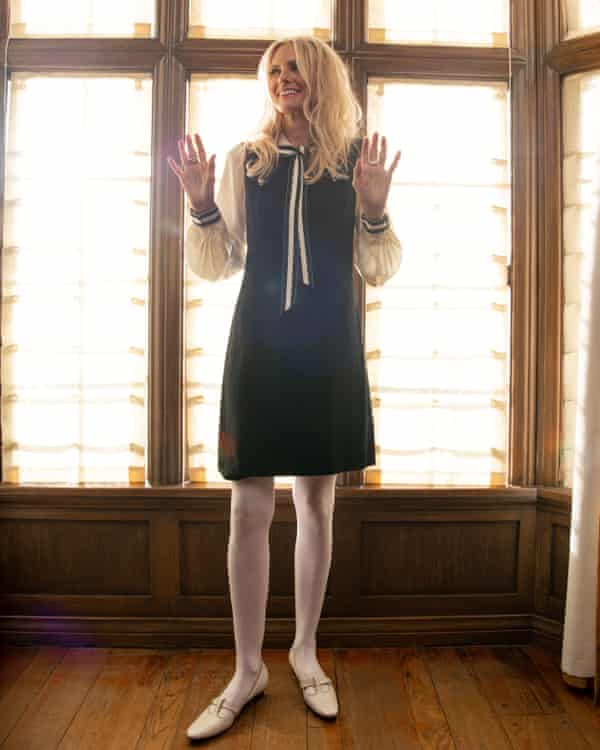
I northward Los Angeles, it'south early and overcast. "It has that six-in-the-morning feel," says Aimee Mann, eternally droll, from a dwelling office wallpapered in fruity foliage. "So it'south been hard to get going." Drab weather demands good knitwear, and Isle of mann has paired thick-rimmed round spectacles the size of ashtrays with a brown woollen sweater vest. She admits, with a whaddaya-gonna-do shrug, that she bought the Alexa Chung garm off Instagram. "I've actually bought several things from Instagram ads," she says sheepishly. "How do they know?"
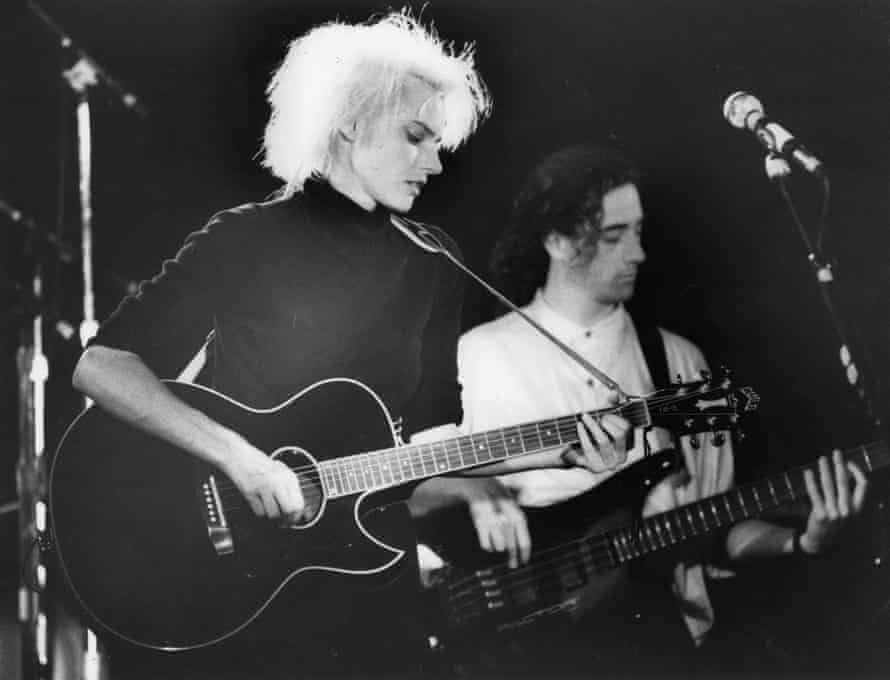
When it comes to her career, the 61-year-old songwriter has never been ane for the hard sell. In 1985, Isle of man's band 'Til Tuesday had a United states of america Top 10 hit with their debut single, Voices Behave, a sublime new-moving ridge anthem about the liability of expressing emotion. With her shocked peroxide exercise, rat-tail plait and unyielding stare, Mann resisted sexual and commercial commodification. Misunderstood by their label, the group ended, then Mann spent the 90s with her offset three solo albums of brilliantly spiky, weary, erudite guitar pop mired in major-label politics, from collapses and buyouts to brazen aloofness at what to do with a late thirtysomething classicist more akin to Randy Newman than Britney Spears.
By the millennium, Mann had quit to kickoff her own label, SuperEgo, where she has remained, releasing wryly tragic character studies of people doomed to self-sabotage. "Equally I've gone on, it's more than interesting to encounter how my past experience can inform a song, only it's not necessarily near me," says Mann. She isn't at all chary in person, but funny and abrupt every bit she reflects for 2 hours, until her stomach rumbles for breakfast.
A few years agone, the film producers Barbara Broccoli and Fred Zollo approached Mann about writing the songs for a musical of Girl, Interrupted, Susanna Kaysen'south 1993 memoir virtually her institutionalisation in McLean psychiatric hospital, in Massachusetts, in the late 60s. Mann read it and "started immediately having ideas for scenes", she says. "I was off and running before there was a script. It'south so obviously in my wheelhouse and I'd written about this stuff earlier." Mann'due south last album, released in 2017, was called Mental Illness, a joke at her dour reputation – one largely imposed on her by men perplexed by this drily funny woman with no taste for sugarcoating. ("I've never understood this ice queen thing myself," wrote the critic Robert Christgau in 2002. "What's the big thrill – getting to see them bite their lip when they come up?")
When the pandemic stalled the play, Mann turned the songs into her new record, Queens of the Summertime Hotel. Mann tells Kaysen's stories over piano and woodwind, the elegant instrumentation plotting the distance betwixt her tormented characters and the expected feminine archetypes of the era to quite beautiful, devastating effect. In a way, it is also Mann'south story, based on a lifetime'due south experience of the tight constrictions of femininity.
In 2002, she checked into the Sierra Tucson rehab centre with PTSD, astringent dissociation, feet and depression. She hasn't previously talked almost information technology publicly. "I only haven't had the distance," she says. Back then, Mann was ostensibly riding a moment of career vindication subsequently all the major-label strife. Paul Thomas Anderson had based his acclaimed 1999 moving-picture show Magnolia on her songs. One was nominated for an Oscar. (She lost to Phil Collins.) Only she was stressed by the pressure to capitalise on the opportunity, including touring heavily. "I started not to be able to function," she says. That year, a drunkard driver hit her tour motorcoach, which flipped three times. She withal played that dark's prove. Although she wasn't injure, "I was really in shock for a long time, and I had a lot of intrusive thoughts virtually the car going over the embankment".
At first she resisted the thought of rehab. "I was a fairly insular person – as much as I'm telling a perfect stranger well-nigh my time in the nuthouse," she says drily. "I didn't desire to be around other people – which is a symptom in itself, when containment becomes the most important thing." But she eased in. "They as well had eating-disorder patients and addicts and alcoholics and sex addicts. Information technology was very interesting to talk to those people and see what you lot had in common. A lot of them came from trauma as well. Information technology's only a variation in how you express it."
Her 2002 album, Lost in Infinite, detailed this menstruum, but simply obliquely. "It's kinda getting harder to breathe," she sang on Pavlov's Bell. "I won't let it show / I'm all about denial / But can't denial let me believe?" Isle of man had watched in the 90s as the post-Girl, Interrupted generation – Prozac Nation writer Elizabeth Wurtzel, Alanis Morissette and Fiona Apple tree – had their unfettered accounts of mental sick-wellness mocked by the media. "I saw that and thought, no way am I telling people what is happening with me," she says.
She had already learned to muffle her feelings every bit a girl of the 60s, when it was "understood that women were stupid", she says, amused yet vociferous at the horror of it all. "The conventional wisdom was that women talked all the time, that they were bad drivers; that if they were unhappy in their marriage, information technology was because they didn't take literally what nature had destined them for. And so you can't make a fucking error, because the mistake is going to be immediately attributed to your gender. They create a box and so put you in the box and then that the box can control you. I think any woman my age is traumatised by growing up in the 60s and 70s because information technology was so relentless."
Even by those standards, Isle of mann'due south girlhood was extreme – the source, she thinks, of her PTSD. She was born in Richmond, Virginia, in 1960. When she was three, her mother got significant by a guy who worked for her male parent, and they kidnapped Mann and ran off to Europe. (Hence her anxiety nearly travelling.) Her male parent hired a individual detective, who brought her habitation a yr later to a new stepmother and two stepbrothers. Her new family members mocked her for wanting to play sports and musical instruments – in the 60s southward, this was unladylike and might deter potential husbands.
"The reasoning was so circular," she recalls. "You would say: 'Well, why can't I do that?' 'Because yous're a daughter.' I would literally experience fucking crazy. You cannot reveal yourself." Stoicism became all she had. "I recall beingness eight years sometime and being really proud that I was able to control my face then it wouldn't make a fucking expression. In my family unit, if you looked unhappy or distressing, the stepmother would say y'all were sulking. I hateful, my fucking mother left when I was three years old – perchance I would have been sad! But if you looked happy, somebody would be like, this is a thing I can use confronting y'all."
She apologises for sounding bitter, although she doesn't at all. Her mother died of lung cancer in 2018. They didn't come across each other frequently, until the cease, when Mann forgave her. "I told her, I get why this happened – that guy had a combination of charm and neediness that was probably very compelling. And once she'southward pregnant, what are you going to do? She's trapped on every side." That sort of mercurial figure recurs throughout Mann's catalogue, notably on 2012'south rocky Charmer, in which she delved into the egotistic psyche and its unsettling appeal. "I personally never found him charming, even at 3, because I knew he was mean," says Mann. "He would do a game where he would compression you really difficult – and that's not a game, right? – and go: 'What, that hurts?' And and then he would practise information technology once more."
Mann looks 20 years younger than she is, and then it'due south easy to forget that she was xvi when punk hit – the perfect age for David Bowie and Iggy Pop to inspire a repressed suburban girl to dye her hair lurid colours. "It was a revelation," she says. "I played three chords on the acoustic guitar. I wasn't actually a musician. But the punk and new wave scene was and then interesting, and then inventive – literally do whatever you want. That Patti Smith was out there and people were accepting her? Oh my God, in that location's a manner out."
She left Virginia for music school in Boston, and then quit to join bands. What gave her the gumption to go? "Part of it is that I knew I was really unequipped to be able to do anything else," she says. "You lot know y'all don't really fit in the normal world." After stints in atonal punk ring Immature Snakes, and industrial metal grouping Ministry, Mann formed 'Til Tuesday and asserted, even in their earliest local press clippings, that they were going to make it.
She's always been a expert judge of her own songwriting, she says ("it's not as bad as what'south on the radio and that'southward got to count for something") and craved success because "in that location wasn't a woman making the kind of music that I wanted to hear". Joni Mitchell one time praised the detailed range of emotions and anxieties that Isle of man expressed in her music. Nonetheless, she had no desire for distinction. "The attention I got in my family was negative attention. I equated that to: if somebody looks at y'all, it'southward non skilful because yous're going to be criticised or yelled at or made fun of. I wanted to play music, just I didn't like the idea of existence in an airport and people looking at me. It's that fauna instinct – when another animal is staring at you, you physically experience it as a threat."
But her greatest problem was the music manufacture defaulting on punk's promise of freedom. In the 80s, the label worked 'Til Tuesday to death. "Their attitude towards artists is they take a stable of horses and they want to hitch a couple up to a carriage," says Isle of mann. "And if i of them dies on the task, you just put some other equus caballus in at that place. They don't care." Being on the road with 'Til Tuesday was then intense that she in one case contemplated cut her hand – enough to wound, not maim – to enforce a interruption. In the mid-90s, Mann, at present solo – and repeatedly battling label execs who said they "didn't hear a unmarried" on her albums – found herself on Geffen, as well dwelling house to Nirvana. "I call up having a conversation with someone at Geffen [who was] very shocked that Kurt Cobain had killed himself. They had a minute where they were like, perhaps we should consider the mental health of artists on the road because it'southward very unnatural."
It took her years to button back. "If your main survival technique was to be a people-pleaser, it's really difficult to non do that. Women peculiarly have their careers controlled by this threat that you volition be perceived as difficult." One new song, You Don't Accept the Room, speaks to the nonexistent margin for mistake that women face. Information technology fits the Girl, Interrupted story as much as it does Britney Spears, who has said she is afraid she volition be judged harshly in one case her conservatorship ends. "Information technology's a fucking crime," Isle of man says of Spears' situation. "Talk about the prize equus caballus beingness hitched upwardly to the automobile and not letting that gravy train stop."
Mann quit the major organisation equally presently every bit she could, buying dorsum the rights to her then-unreleased 2000 album, Available No ii or, the Last Remains of the Dodo (its title a comment on the plight of the songwriter). "I was sick of asking for permission to make the music I wanted to make," she says, "which I never felt was so crazy or left of center. I'm not John Cage."
The pressures abated somewhat; Isle of man moved to Los Angeles and in 1997 married Michael Penn (brother of actor Sean). They joined the songwriting community around local club Largo, and barbarous in with likeminded comedians. It says something near the open-mindedness of comedy that information technology took Isle of mann'south appearances on the sketch shows Portlandia and Tim and Eric Awesome Prove, Great Chore! to expose her to younger listeners. (In 2018, pop star Sky Ferreira, who has also battled the major label system, released a fantastic cover of Voices Carry.)
Echoing the potential that Patti Smith showed her as a teenager, Mann is at present role of the limited vanguard of older women in music who survived manufacture hostility to create into their 60s and beyond, from Kim Gordon to Marianne Faithfull. It's challenging to age in a business organisation that is "100% obsessed with the way people await, and now more than than always," says Mann. "In the 60s, yous had a lot of singers who were non that attractive, but they could sing and that was the point." After existence held to narrow standards of femininity, turning l "and I'm supposed to go, oh, who cares what I wait like?" she says. "That's a hard mental exercise."
You would call the past decade Mann's prime number if that didn't elide her consistency. Merely last twelvemonth well-nigh stalled her headway. While mastering Queens of the Summer Hotel, she idea her computer speakers were broken and called Penn in to check. He said they sounded fine. Mann's hearing had become distorted thanks to a nervous system disorder. She developed vestibular migraines and became ill and dizzy. Beset past tinnitus, she couldn't mind to music for a year. "All my sensory input was distorted and overloaded – light from a phone or a computer made me sick, and I felt like I had a terrible hangover or concussion all the time."
She figured there had to be a connection with her PTSD – or perhaps from a childhood concussion sustained when her mother'due south boyfriend crashed the car. She saw seven neurologists. One prescribed medication that fabricated Mann psychotic, driving her to suicidal ideation. And so one asked whether she had a history of trauma – survivors showed a higher incidence of migraines. He told her to keep going to therapy and processing her past.
"And and then I got an advertizing on Instagram for an app – and I cannot believe that this is the story," she says with comic disbelief.
This chronic pain management app, based on cognitive behavioural therapy, confirmed what the doc said – that babyhood trauma "with additional stress – similar, I don't know, maybe being isolated in a pandemic! – makes your system actually reactive. And when your nervous system is reactive, it starts sending out pain signals because it feels mistakenly like it'due south in danger. I was like, that'south fucking it!"
She laughs. "Betwixt the belong and the app on Instagram, I'm like, all right, maybe there's 1% good in the ocean of evil."
Isle of mann had thought she might never work once again. "Music was and so unpleasant, and there was no solace in it," she says. The prospect was especially dour given that she had but recently learned to truly honey performing. When her health improved, she attempted live rehearsals, hoping to make it through 5 songs as a get-go. "It was so magical to play with these other people that information technology literally started to heal and calm my nervous system," she says. "I realised that not seeing other people [in lockdown] was so stressful for me. People underestimate that nosotros're pack animals."
Mann still has some hearing distortion, significant no guitar-heavy records for at present. While she was unwell, she started work on a graphic memoir – she'due south a huge comics fan (she has a song named Ghost World and the cartoonist Seth drew the artwork for Lost in Space) and the format reminded her of songwriting. "The artwork gives you a feeling that'southward a little like the feeling music gives y'all," she says. "And the dialogue has to be very specific."
It's difficult for her to see the overarching narrative of her story. Whereas she's a good judge of her own songwriting, "information technology'south pretty hard to be objective about an unabridged life", she says. "What to leave out, what to keep in." Non to mention the fourth dimension information technology takes to heal. "I was stubborn?" she suggests. "And I kept moving forward regardless of obstacles. Maybe that's it."
Queens of the Summertime Hotel is out now on SuperEgo Records
jeffersonwelaidene.blogspot.com
Source: https://www.theguardian.com/music/2021/nov/04/aimee-mann-any-woman-my-age-is-traumatised-by-growing-up-in-the-60s-and-70s
Belum ada Komentar untuk "Aimee Mann Mental Illness Album Art Pharmakon Contact Album"
Posting Komentar